
About Batom (greattaiwangear.com)
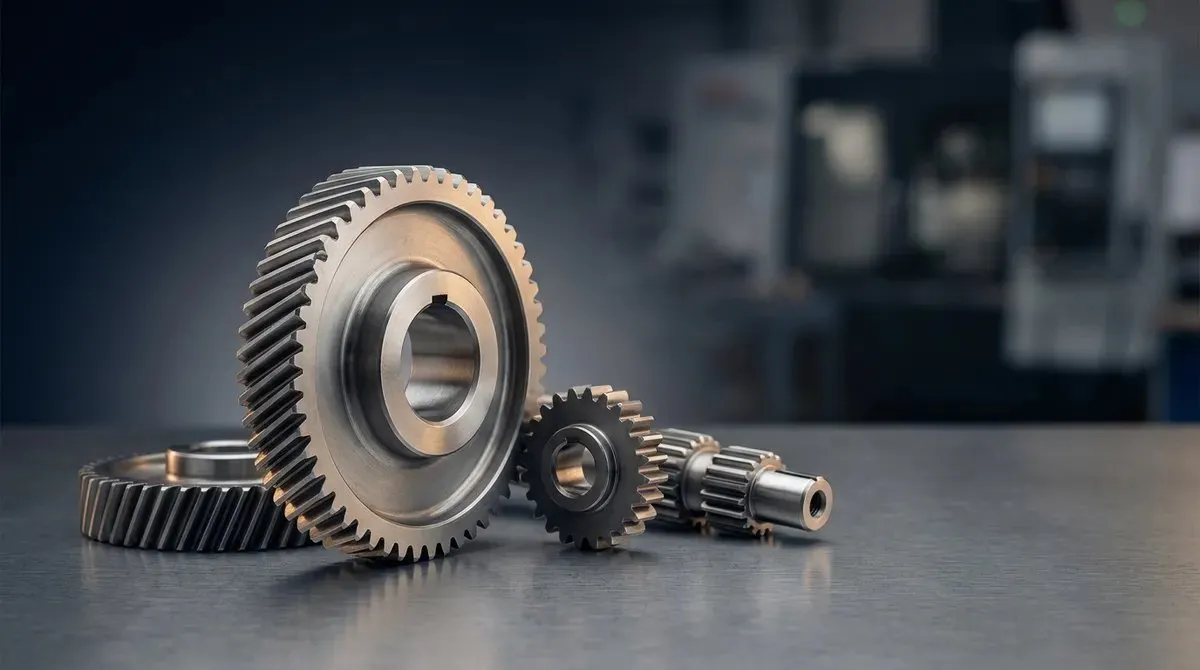
Batom Co., Ltd. builds gears for the machines that move the world. Founded in 1981 and headquartered in Taichung, Taiwan, the company has spent more than four decades developing the engineering depth and manufacturing precision required to serve the most demanding gear applications across automotive, aerospace, electric vehicles, and industrial equipment.
The company's positioning — "Gears for the Electric Age" — reflects a deliberate strategic shift. While Batom's roots are in conventional automotive and industrial gear manufacturing, a substantial portion of its current engineering investment targets EV drivetrain components, where noise requirements and precision tolerances have escalated well beyond what the industry considered standard a decade ago.
Batom operates from its main production facility in Taichung, with international offices in the United States (established 1994) and Mexico (Avenida Innovacion 114, León, Guanajuato). This three-location structure gives the company direct access to Asian, North American, and Latin American supply chains — a configuration that has become increasingly valuable as OEMs diversify their sourcing strategies.
What Batom Makes
The company's product portfolio spans four major sectors, each with distinct precision and reliability requirements.
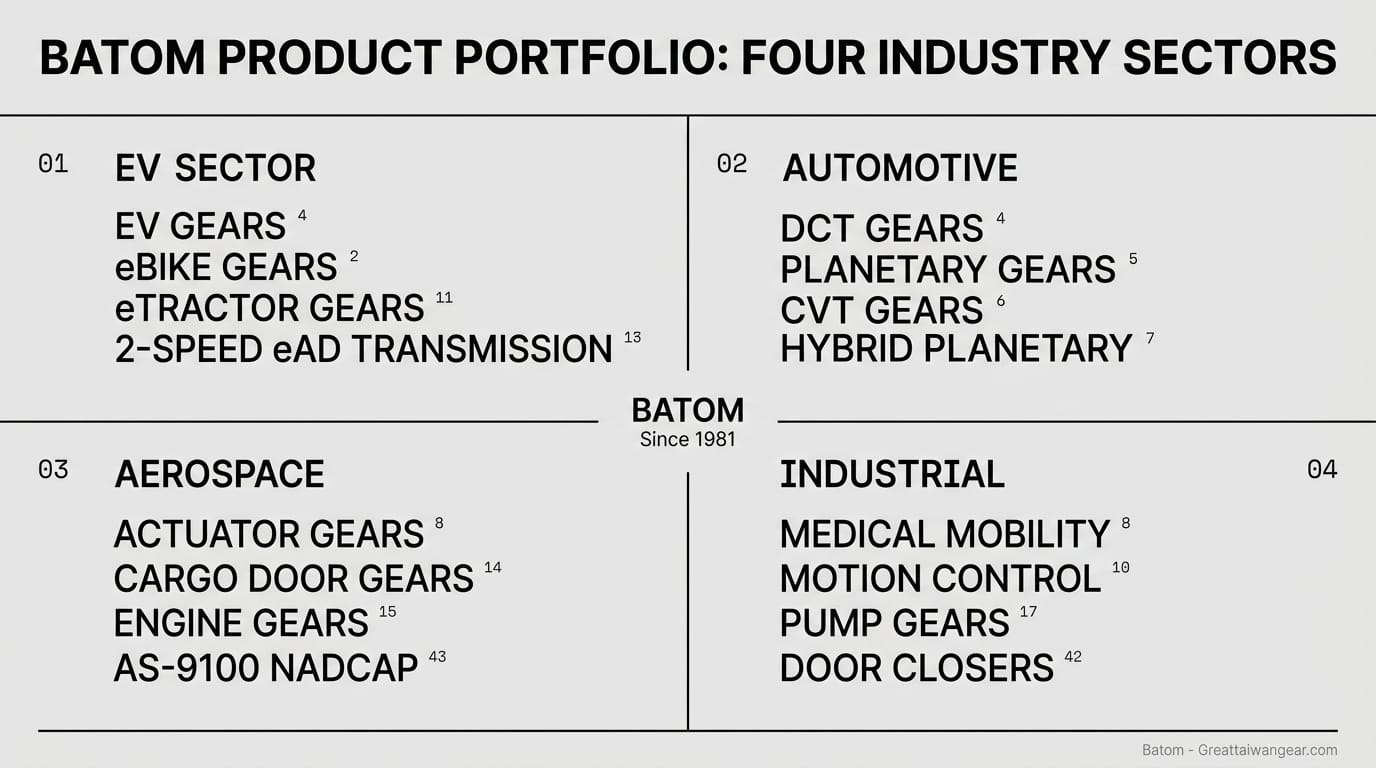
Electric Vehicles. Batom produces EV gears, gear sets, pinion gears, and shafts for electric cars, along with eBike gears and electric tractor gear sets. The company also provides EV transmission solutions including components for 2-Speed eAD Transmission systems. EV gears require exceptionally tight control over NVH (noise, vibration, and harshness) because electric motors produce almost no masking noise. Every imperfection in the gear mesh becomes audible inside the cabin, which makes manufacturing precision the primary differentiator in this segment.
Automotive. The company supplies DCT (dual-clutch transmission) gears and shaft sets, planetary gear assemblies, and CVT components to global Tier 1 suppliers and terminal car factories. Batom's development of DCT and hybrid planetary gear systems placed the company in the advanced transmission supply chain years before the current electrification wave.
Aerospace. Batom manufactures gears for actuators, cargo door systems, and aero engines. These applications demand the highest material and dimensional standards in the gear industry. The company's AS-9100 and Nadcap certifications underpin its qualification to supply into aerospace programs.
Industrial. The portfolio includes gears for medical mobility equipment, motion control systems, pumps, and door closers. These applications prioritize long service life and consistent performance under varying load conditions.
Manufacturing Capabilities
Batom's technical differentiation comes from its ability to handle complex gear geometries and apply specialized correction processes that directly affect noise and durability performance.
The company's advanced processing capabilities include gear profile modification (controlling the contact pattern across the tooth face to minimize transmission error), lead modification (compensating for elastic deformation under load to ensure full-face contact), twist correction, and surface waviness control. According to the company, these techniques enable manufacturing of "complex diversified gear variations" — a shorthand for the reality that no two gear applications have identical requirements, and each demands specific micro-geometry adjustments.
The manufacturing service model covers the complete cycle from new product sample development through mass production. Batom invests continuously in the latest production technology and automation, with particular emphasis on inspection equipment capable of characterizing the micro-geometry features that govern NVH performance in EV applications.
Quality Systems and Certifications
Quality management is the foundation of Batom's market position. The company maintains one of the most comprehensive certification portfolios in the precision gear manufacturing sector:
| Certification | Scope |
|---|---|
| IATF 16949 | Automotive quality management |
| AS-9100 | Aerospace quality management |
| Nadcap | Special process accreditation (heat treatment) |
| ISO 9001 | Quality management system |
| ISO 14001 | Environmental management |
| ISO 45001 | Occupational health & safety |
Holding both IATF 16949 and AS-9100 is uncommon for a single gear manufacturing facility. Automotive and aerospace quality systems have different audit philosophies and documentation requirements. Maintaining both demonstrates a level of process maturity that translates directly into manufacturing consistency — the gear you receive on the thousandth piece matches the first.
The Nadcap accreditation deserves specific attention. Nadcap (National Aerospace and Defense Contractors Accreditation Program) audits special processes like heat treatment, which is critical for gear performance. Heat treatment controls the hardness gradient from the tooth surface into the core, the residual stress profile, and the dimensional stability of the gear after quenching. Variations in any of these parameters affect noise, wear resistance, and fatigue life. A Nadcap-certified heat treatment process provides the traceability and consistency that high-stakes applications require.
In 2020, Batom received Taiwan's 29th National Award of Outstanding SMEs (國家磐石獎), administered by the Ministry of Economic Affairs. This award evaluates business performance, R&D innovation, human resource development, and social responsibility. It is considered the highest recognition for small and medium enterprises in Taiwan.
Company History
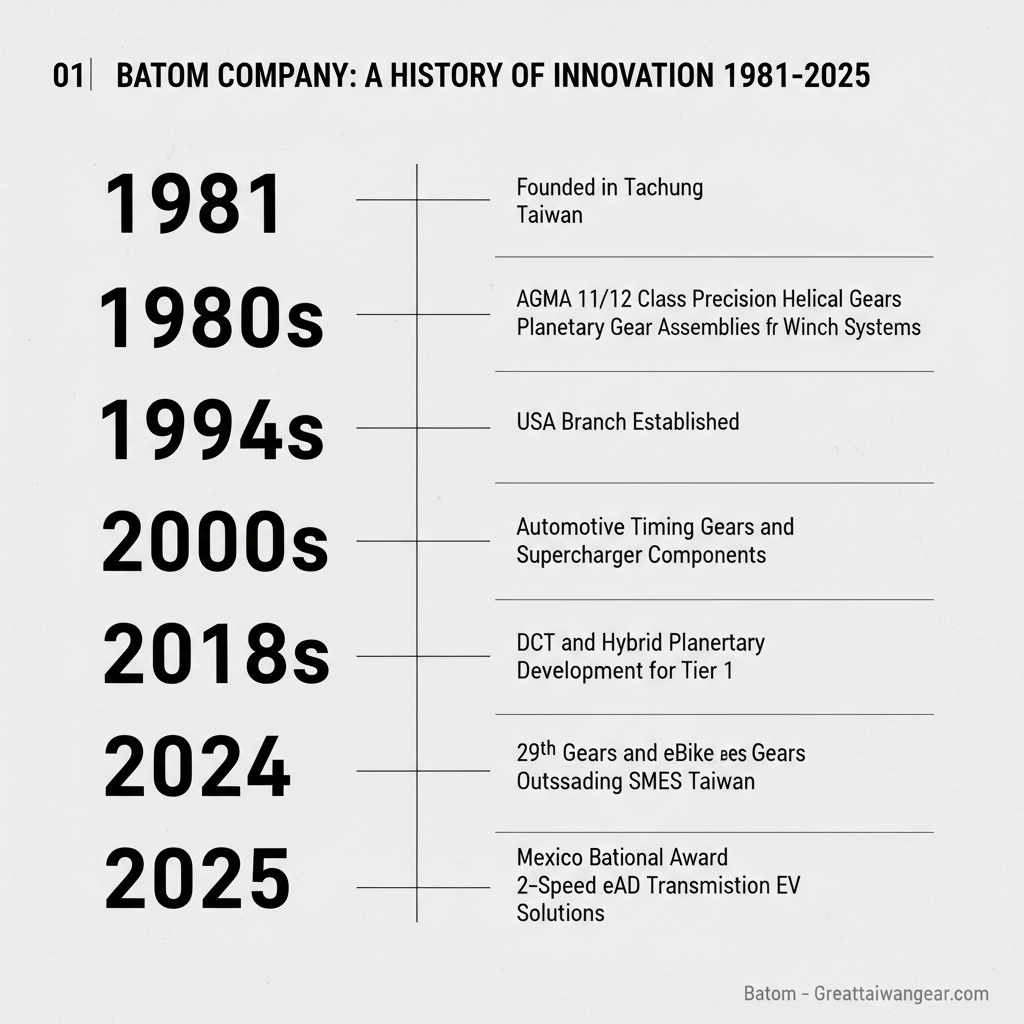
Batom's evolution tracks the broader story of Taiwan's precision machinery industry.
The company started in 1981 with fundamental gear manufacturing. The early focus on building machining competence at progressively tighter tolerances paid off as the product line expanded. The development of AGMA 11/12 class precision helical gears marked an early milestone — these accuracy grades are associated with high-speed, low-noise applications that require grinding or precision hobbing to achieve.
Planetary gear assembly production followed, initially for winch applications, then expanding into automotive and EV platforms. Entry into the medical mobility sector added another dimension of quality requirements, since medical device components face regulatory scrutiny on top of standard manufacturing quality expectations.
The automotive timing gear and supercharger component work established Batom's credentials with car manufacturers. DCT and hybrid planetary gear development for Tier 1 suppliers then placed the company in the advanced transmission supply chain — a position that proved strategically important as the industry shifted toward electrification and multi-speed EV transmissions.
The 1994 establishment of the U.S. branch was a critical internationalization step. Direct North American presence shortened lead times for U.S. customers and eliminated communication barriers that frequently slow technical collaboration between Asian manufacturers and Western OEMs. The Mexico branch in León (a major automotive manufacturing hub in the Bajío region) extended this reach further into the USMCA trade zone.
The People Behind the Gears
Batom states directly: "Our most important resource is our people." In precision gear manufacturing, this is a statement with real operational implications. Gear grinding, heat treatment control, and metrology interpretation all require operator skill built over years of experience. A machine can be programmed, but the judgment calls — adjusting a grinding wheel dress for a specific steel grade, interpreting a waviness measurement that sits on the border of specification — come from trained people.
The company's investment philosophy pairs human expertise with equipment upgrades. Continuous investment in production technology and automation extends what skilled operators can achieve, while advanced inspection equipment gives them the measurement data needed to maintain tight process control.