
Batom Story: From a Taiwan Gear Shop (1981) to Global EV Transmission Supplier
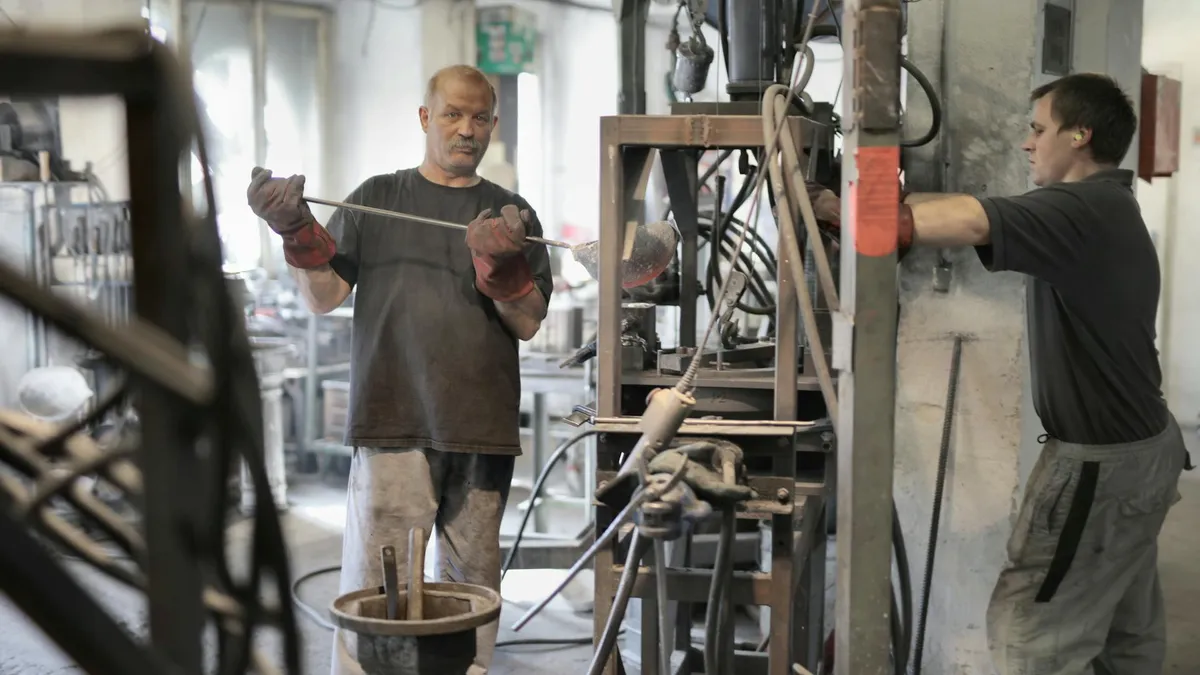
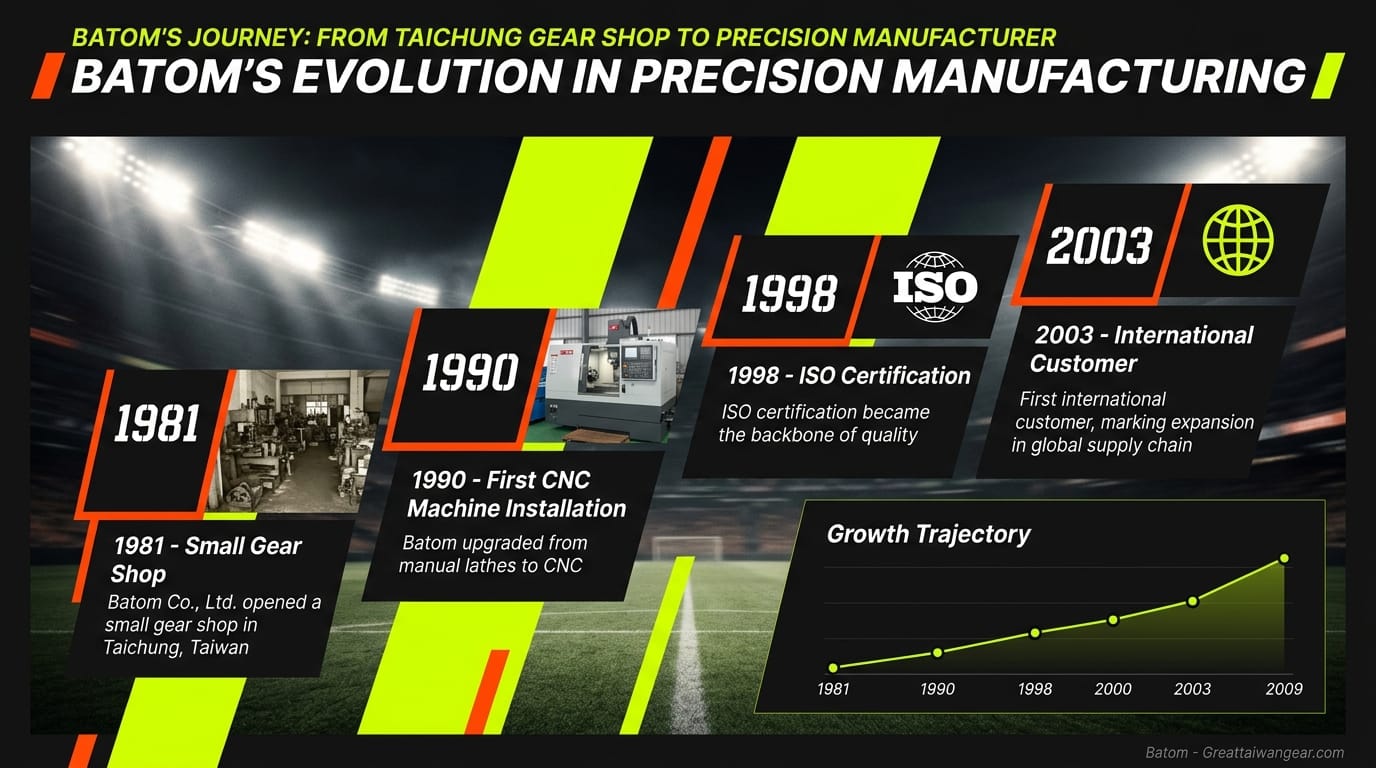
In 1981, Batom Co., Ltd. opened a small gear machining workshop in Dali District, Taichung City. The company cut industrial gears and tooling components for local manufacturers. Forty-four years later, Batom supplies precision gears to major global electric vehicle brands and has developed Taiwan's first domestically developed two-speed EV transmission module (ITRI collaboration). This article traces the company's transformation from a traditional contract manufacturer into an integrated EV drivetrain supplier, and examines the strategic decisions that made the shift possible.
The Foundation: Industrial Gears and the Taichung Cluster
Taichung's Dali District was a hub for metalworking and precision machining throughout the 1980s. Dozens of small- and mid-sized factories clustered along a supply chain that ranged from raw material processing to finished component delivery. Batom built its early reputation on gear hobbing, heat treatment, and precision grinding — the three core processes that define a gear manufacturer's capability ceiling.
The first major strategic move came in 1994. Batom established Great Taiwan Gear, a U.S. subsidiary based in Greer, South Carolina. The timing coincided with the North American automotive industry's push for QS 9000 quality certification among suppliers. Setting up a physical presence in the U.S. signaled that Batom's leadership viewed international certification and direct customer access as long-term competitive priorities, not optional extras.
Certifications That Open Doors — and Keep Competitors Out
Automotive gear manufacturing operates under some of the tightest quality requirements in precision machining. IATF 16949, the global standard for automotive quality management systems, functions as a non-negotiable entry requirement for any supplier seeking to work with major OEMs. Over 100,000 certified sites exist worldwide, according to IATF data.
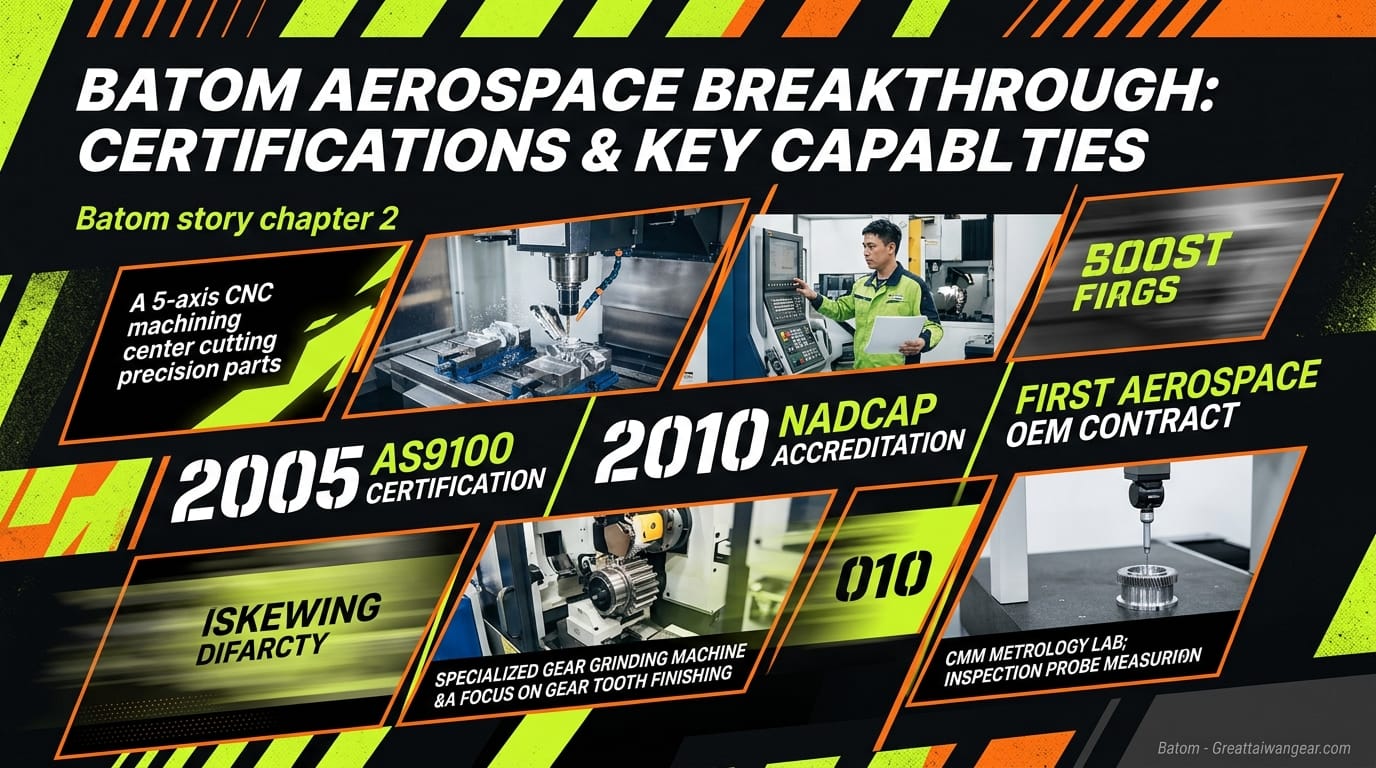
Batom holds IATF 16949 certification alongside Nadcap accreditation for non-destructive testing (NDT), compliant with ASTM E1444 magnetic particle inspection standards and approved through Honeywell Aerospace / Moog customer audits, a credential rooted in aerospace manufacturing. This dual certification is uncommon among Taiwanese gear manufacturers, and the cost of maintaining both — annual surveillance audits, process documentation, and continuous improvement mandates — places meaningful strain on smaller companies.
The strategic logic is straightforward: high certification barriers function as a moat. Competitors lacking the resources or organizational discipline to maintain these certifications cannot access the same customer base. Batom's quality management infrastructure spans the full production cycle, from gear design and analysis through final inspection.
From ICE Transmissions to EV Drivetrains
Batom's product milestones track a clear technology progression. The early product portfolio focused on manual transmission gears and industrial applications. Over the following decades, the company expanded into automatic transmission (AT), dual-clutch transmission (DCT), and continuously variable transmission (CVT) gear sets.
Electric vehicles introduced a fundamental shift in drivetrain requirements. Internal combustion engines produce peak torque within a narrow RPM band (typically 2,000–5,000 RPM), which is why ICE vehicles need multi-speed gearboxes. Electric motors deliver peak torque from 0 RPM and operate across a range exceeding 16,000 RPM. Most production EVs use a single-speed reduction gear with a fixed ratio between 7:1 and 10:1.
The simplification is deceptive. EV gears spin faster and face stricter noise constraints. Without engine noise to mask gear mesh sounds, transmission noise becomes the dominant cabin intrusion source. Industry benchmarks call for peak-to-peak transmission error (PPTE) in EV gears below 50% of ICE gear tolerances, yielding roughly a 6 dB noise reduction. Batom achieves PPTE < 3μm via gear profile modification, with gear accuracy rated to AGMA Class 14 / DIN 3962 Class 4 or better.
Batom's EV gear portfolio now spans individual gears, gear sets, planetary gears, and shafts. Three complete drivetrain solutions anchor the EV product line:
| Product | Application | Key Specification |
|---|---|---|
| 2-Speed eAD Transmission | Passenger EVs / commercial vehicles | Dual-ratio design, 4.3% energy savings (NEDC simulation), ~45 kg |
| ES30 E-Scooter Gearbox | Electric scooters | Lightweight, optimized for two-wheel EVs |
| EDM1-S-P95 3-in-1 System | Integrated EV drivetrain | Motor, inverter, and reduction gear in one unit |
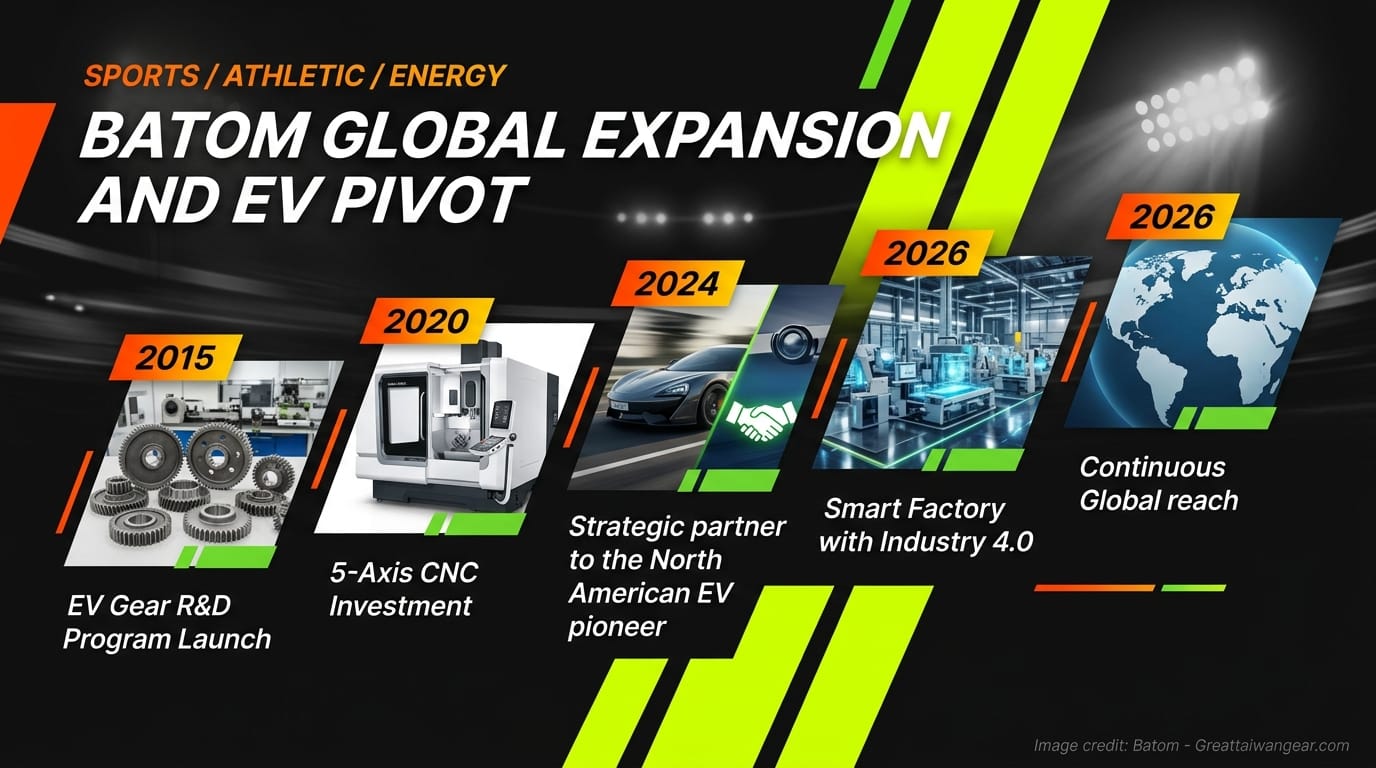
The 2-Speed eAD deserves particular attention. Dual-speed EV transmissions remain rare in production vehicles — Porsche's Taycan is among the few production models using a two-speed design (supplied by ZF). Batom's two-speed EV transmission module was independently developed to accumulate core drivetrain technology. It is not yet deployed in commercial production vehicles, reflecting a deliberate long-term strategy to build in-house R&D expertise ahead of market demand. A two-speed design enables higher torque at low speeds (for hill climbing and acceleration) and improved efficiency at cruising speeds.
Smart Manufacturing: The LCIM Approach
The transformation extends beyond products. Batom's general manager, Lin Yi Min, has publicly outlined the company's smart manufacturing strategy under the LCIM framework — Low Cost Intelligent Manufacturing. The approach targets 24-hour autonomous production through six automation layers: production, loading/unloading, measurement, feedback, logistics, and warehousing. Internal estimates suggest continuous production delivers four times the output of conventional shift-based operations.
The management dimension matters as much as the hardware. Batom is migrating from batch-level tracking to individual-piece traceability — a practice standard in electronics manufacturing but still uncommon among traditional automotive parts makers. Per-piece traceability provides exact machining parameters and quality data for every gear produced, a capability increasingly demanded by OEM customers running zero-defect programs.
Market Context: EV Transmission Growth
Batom's timing aligns with a rapidly expanding addressable market. Persistence Market Research valued the global EV transmission market at USD 12.8 billion in 2025, with projections reaching USD 28.6 billion by 2032 at a 12.8% CAGR. Asia-Pacific accounts for approximately 45% of this market, with China as the dominant single-country contributor.
The IEA's Global EV Outlook 2025 reported that global EV sales exceeded 17 million units in 2024, a year-over-year increase of more than 25%. Battery electric vehicles (BEVs) represent roughly 90% of EV transmission demand, with single-speed reduction gearboxes as the default architecture.
For a company like Batom, this market structure presents a trade-off. BEV dominance concentrates demand in single-speed gears, which carry lower per-unit pricing than multi-speed transmission gear sets. Volume growth compensates for the pricing gap. The two-speed transmission targets a premium and commercial vehicle niche that is growing but has not yet reached mainstream adoption.
Taiwan's SME Playbook for Industrial Transition
Batom's trajectory offers a concrete reference point for Taiwan's automotive component sector. The island's parts industry consists primarily of small and medium enterprises. A CENS industry report describes the structure: upstream manufacturers supply seats, pistons, and gears; midstream suppliers contribute dashboards, bumpers, and generators; downstream producers deliver integrated engine, steering, and ADAS systems.
ARTC (Automotive Research & Testing Center) estimates that Taiwan now has roughly 500 automotive electronics companies, with combined 2024 output of approximately TWD 16.5 billion (about USD 500 million). The projection for 2028 exceeds TWD 30 billion.
Batom's case demonstrates that upgrading from a traditional gear job shop to a global EV supplier requires simultaneous progress on four fronts: certification depth (IATF 16949 + Nadcap), manufacturing intelligence (LCIM automation), product pivot (ICE → EV drivetrain systems), and international market access (U.S. subsidiary). Of these, international certification and local service capability are often undervalued by manufacturers who treat technology as the sole differentiator.
Sources
- SAE International — Automotive engineering standards and research
- International Energy Agency (IEA) — Global EV Outlook 2025 — Global EV market data
- Persistence Market Research — EV Transmission Market — Market size and growth forecasts
- McKinsey & Company — Automotive & Assembly — Supply chain transformation analysis
- World Economic Forum — Future of Jobs Report 2025 — EV workforce trends
Editor's Perspective
Author: Batom Co., Ltd. Marketing Department
Tracking Batom's four-decade trajectory reveals that the most consequential decisions were not about any single product. The company placed bets on international certification, overseas presence, and pre-market R&D investment before the returns were clear. When the EV transition accelerated, these foundational investments became competitive advantages that late movers could not replicate quickly. The two-speed EV transmission was developed while production orders were still uncertain — a risk tolerance pattern that distinguishes companies which survive paradigm shifts from those that merely react to them.
Ready to explore EV transmission gear supply or gearbox development partnerships? Schedule a consultation with Batom's engineering team to discuss your drivetrain requirements.
Frequently Asked Questions
Q: When was Batom founded? A: Batom Co., Ltd. was established in 1981 in Dali District, Taichung City, Taiwan. The company started as a small gear machining workshop focused on industrial gears and tooling components for local manufacturers.
Q: Does Batom make EV transmissions? A: Yes. Batom manufactures a range of EV drivetrain components including individual gears, gear sets, and three complete transmission systems: a 2-speed eAD transmission for passenger and commercial EVs, an ES30 gearbox for electric scooters, and an EDM1-S-P95 three-in-one integrated system.
Q: What certifications does Batom hold? A: Batom holds IATF 16949 certification for automotive quality management and Nadcap accreditation for non-destructive testing (NDT), compliant with ASTM E1444 magnetic particle inspection standards and approved through Honeywell Aerospace / Moog customer audits. This dual certification qualifies the company for both automotive and aerospace supply chains.
Q: What is a two-speed EV transmission? A: A two-speed EV transmission uses two gear ratios instead of the single fixed ratio found in most electric vehicles. The lower ratio provides higher torque for acceleration and hill climbing, while the higher ratio improves energy efficiency at cruising speeds. Batom's version achieves a 4.3% energy efficiency gain in NEDC simulation testing.
Q: Where is Batom located? A: Batom's headquarters and primary manufacturing facility is at No. 45, Siyu Street, Dali District, Taichung City 41279, Taiwan. The company also operates a U.S. subsidiary, Great Taiwan Gear, based in Greer, South Carolina.
Batom Co., Ltd. Headquarters: No. 45, Siyu St., Dali Dist., Taichung City 41279, Taiwan | Phone: +886-4-24929678