
How to Choose a Gear Manufacturer: 12-Point Buyer's Checklist (2026)
Choosing the wrong gear supplier costs more than the price gap between quotes. Hidden quality failures — warranty claims, line stoppages, NVH rework — can run 15% to 25% of total procurement spend, according to AIAG cost-of-poor-quality benchmarks. This 12-point checklist distills the evaluation criteria that experienced procurement teams use to separate capable long-term partners from suppliers who look good on paper.
Each criterion includes a specific verification method and a pass/fail threshold. The goal: eliminate high-risk candidates early and concentrate due diligence on manufacturers who can actually deliver.
1. Quality Management Certifications
Certifications reveal how mature a supplier's quality system actually is. IATF 16949 remains the baseline for automotive supply chains. The current 6th Edition (2025) emphasizes risk-based audit planning and supplier monitoring, with increased focus on process accountability and supply chain transparency. ISO 9001 covers general quality management. AS9100 is mandatory for aerospace.
How to verify: Request copies of valid certificates and confirm the issuing body is IATF-recognized. Check that the certification scope covers your specific product category and manufacturing processes. Suppliers with international certifications and industry awards have typically survived multiple external audits — a reliable proxy for system maturity.
2. Gear Accuracy Class and Metrology Capability
Accuracy class determines real-world performance in noise, vibration, and service life. AGMA classifies gear quality from Q3 to Q15, with higher numbers indicating tighter tolerances. ISO 1328 and DIN standards are also widely used. Cross-referencing between systems is possible but not straightforward — the scales are not identical.
How to verify: Confirm the supplier's manufacturing specifications explicitly state achievable AGMA or ISO accuracy classes. Tour the metrology lab. Look for gear profile testers, coordinate measuring machines (CMMs), and surface roughness instruments. The four critical parameters: tooth profile error, lead error, pitch variation, and radial runout.
3. Design and Engineering Support
A capable gear manufacturer contributes more than production capacity. The best partners offer gear geometry design, finite element analysis (FEA), tooth contact analysis (TCA), and process simulation — capabilities that reduce iteration cycles and catch design issues before tooling cuts.
How to verify: Ask whether the supplier provides custom gear design and analysis services. Identify which CAD/CAE platforms they use. Request case studies showing measurable design optimization results — for example, transmission error reduction through flank microgeometry modification. Suppliers with OEM gear design and development experience tend to respond faster to engineering changes.
4. Material Selection and Heat Treatment
Material grade and heat treatment process directly govern load capacity and fatigue life. Common automotive gear steels include SCM420, SCM822, and 20CrMnTi alloys. Carburizing is the dominant surface hardening method for high-performance applications.
How to verify: Request mill certificates from raw material suppliers and confirm incoming hardness inspection records. If heat treatment is outsourced, audit the subcontractor's certification status and process controls independently. Consistency in effective case depth and core hardness across production batches is the clearest indicator of heat treatment quality.
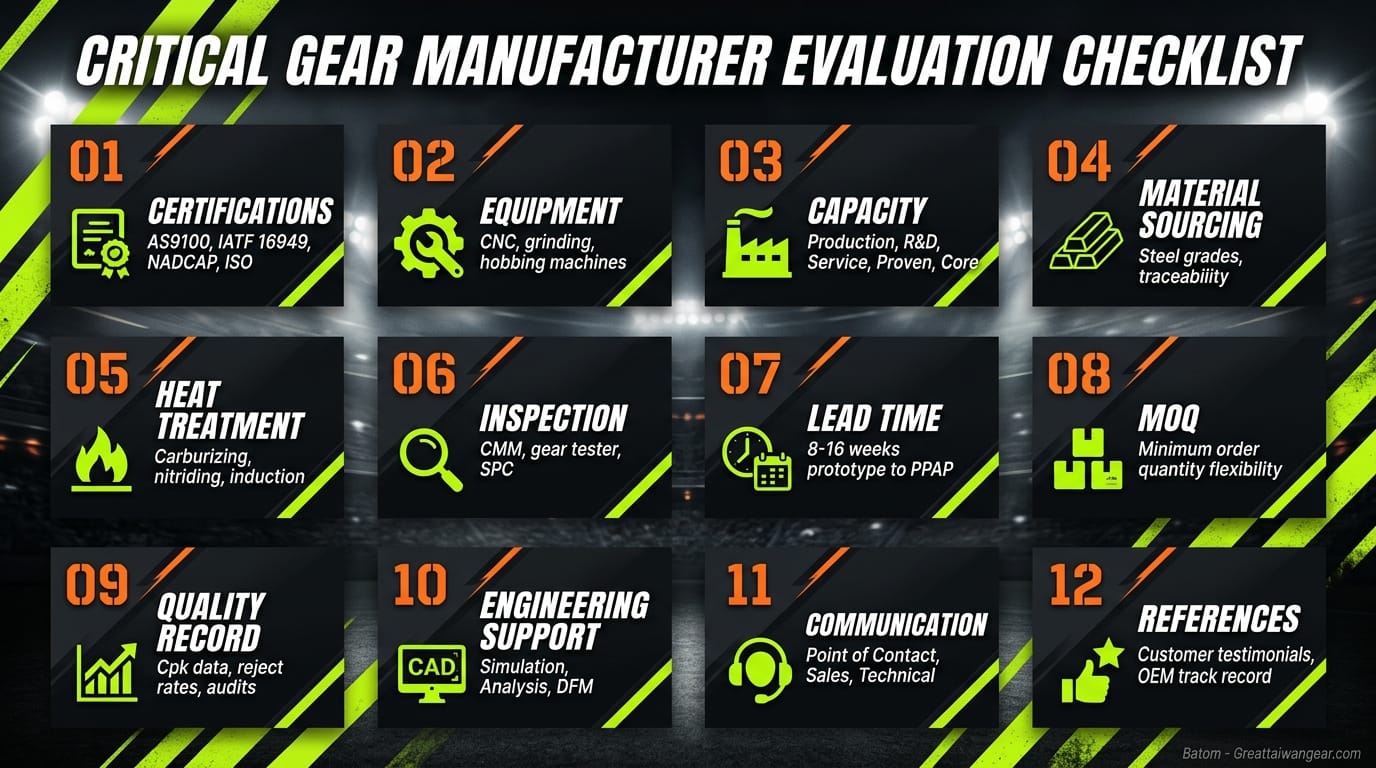
5. Manufacturing Equipment and Capacity
The equipment list defines the supplier's actual capability boundaries. Core gear manufacturing processes include hobbing, shaping, grinding, and shaving. CNC-controlled machines improve changeover efficiency and dimensional consistency. Manual-heavy operations are a concern for tight-tolerance work.
How to verify: Request a detailed equipment list including brand, model, maximum workable module, and machine age. Review preventive maintenance records. Monthly capacity and current utilization rate are both important — utilization above 90% signals lead time risk, while abnormally low rates may indicate order instability.
6. Application Range and Industry Experience
Gear requirements vary dramatically by application. Automotive transmission gears, planetary gear sets, and DCT gears and shafts each demand different precision, noise, and durability profiles. Manufacturers with cross-industry experience tend to be more adaptable problem-solvers.
How to verify: Request representative customer references and product specifications by industry (within NDA constraints). For EV gearbox applications, confirm the supplier has NVH management experience specifically. Electric drivetrains have far lower noise tolerance thresholds than conventional ICE vehicles — gear whine that passes in a combustion car becomes unacceptable in an EV cabin.
7. Quality Assurance and Traceability
Full traceability from raw material to finished product is a non-negotiable in modern automotive supply chains. IATF 16949 requires suppliers to maintain lot traceability, corrective and preventive action (CAPA) procedures, and formal complaint management systems.
How to verify: Ask whether the traceability system can link a finished product batch number back to the raw material heat number, heat treatment batch, and individual process inspection records. Confirm that quality assurance protocols include statistical process control (SPC) and measurement system analysis (MSA). Request customer complaint counts and resolution timelines for the past 12 months.
8. Prototyping Speed and PPAP Capability
New product introduction speed directly impacts your time-to-market. The Production Part Approval Process (PPAP) is the standard automotive method for validating a supplier's manufacturing capability across five submission levels.
How to verify: Confirm standard prototyping lead times and ask for recent PPAP submission timelines as evidence. Typically 8–16 weeks total, Batom delivers in ~3 months for prototyping. Process capability index (Cpk) reporting is essential — a Cpk ≥ 1.67 is the standard production release threshold for automotive gears.
9. Delivery Performance and Supply Chain Resilience
Consistent delivery requires systematic capacity planning and inventory management. Key metrics include on-time delivery rate (OTD), safety stock policies, and emergency order handling protocols.
How to verify: Request the past 12 months of OTD data. High-performing suppliers maintain OTD above 95%. Confirm whether the supplier has backup options for sub-tier materials to manage raw material shortages or equipment failures. Gear manufacturers with decades of production history, such as Batom with over 40 years in precision gear manufacturing, typically demonstrate stronger supply chain management maturity.
10. Intellectual Property Protection
Flank modification parameters, tooling designs, and process recipes are often the buyer's core technical assets. A supplier's IP protection framework matters especially for OEM customers developing proprietary drivetrains.
How to verify: Confirm the supplier will sign a non-disclosure agreement (NDA) and that they maintain internal data classification controls. Ask whether they work with any of your direct competitors and what cross-contamination safeguards are in place. Tooling and process data ownership must be explicitly defined in the supply agreement.
11. Sustainability and Regulatory Compliance
ESG compliance has shifted from a bonus to a supply chain gate. The EU's Carbon Border Adjustment Mechanism (CBAM) and Corporate Sustainability Due Diligence Directive (CSDDD) are reshaping supplier evaluation criteria globally.
How to verify: Check for ISO 14001 (environmental management), ISO 45001 (occupational health and safety), ISO 14064-1 (greenhouse gas inventory / carbon audit), and ISO 14067 (product carbon footprint) certifications. Request carbon footprint data or a published sustainability report. For gear products destined for European markets, the supplier should be able to provide RoHS and REACH compliance declarations for all material compositions.
12. Technical Service and Long-Term Partnership Commitment
Post-sale technical support quality is often overlooked during initial sourcing but becomes decisive during serial production. Response speed, proactive problem-solving, and a genuine continuous improvement mindset are more predictive of total cost than the first quote.
How to verify: Evaluate the quality and speed of technical responses during the quoting phase. Schedule a factory audit and assess shopfloor management standards and workforce capability firsthand. Pose a technically challenging scenario and evaluate the depth of the supplier's analysis and proposed solution. Services like commissioned inspection services are a concrete indicator of how far a supplier extends its technical support commitment.
Putting the Checklist to Work
Integrate these 12 criteria into a weighted scoring matrix tailored to your industry. Automotive buyers should weight certifications and traceability at 15% or higher. Precision industrial applications may need heavier emphasis on accuracy class and metrology.
The table below maps each application type to its priority evaluation areas:
| Application | Priority Criteria | Accuracy Target | Special Considerations |
|---|---|---|---|
| Automotive transmission | Certification, PPAP, traceability | AGMA A5–7 / DIN 6–8 | NVH control, IATF 16949 mandatory |
| EV drivetrain | Design support, NVH, materials | AGMA A4–6 / DIN 5–7 | High-speed adaptation, extreme noise sensitivity |
| Industrial gearbox | Capacity, delivery, cost | AGMA A7–9 / DIN 8–10 | Large-module machining capability |
| Aerospace actuator | Certification, traceability, materials | AGMA A3–5 / DIN 4–6 | AS9100 mandatory, full documentation retention |
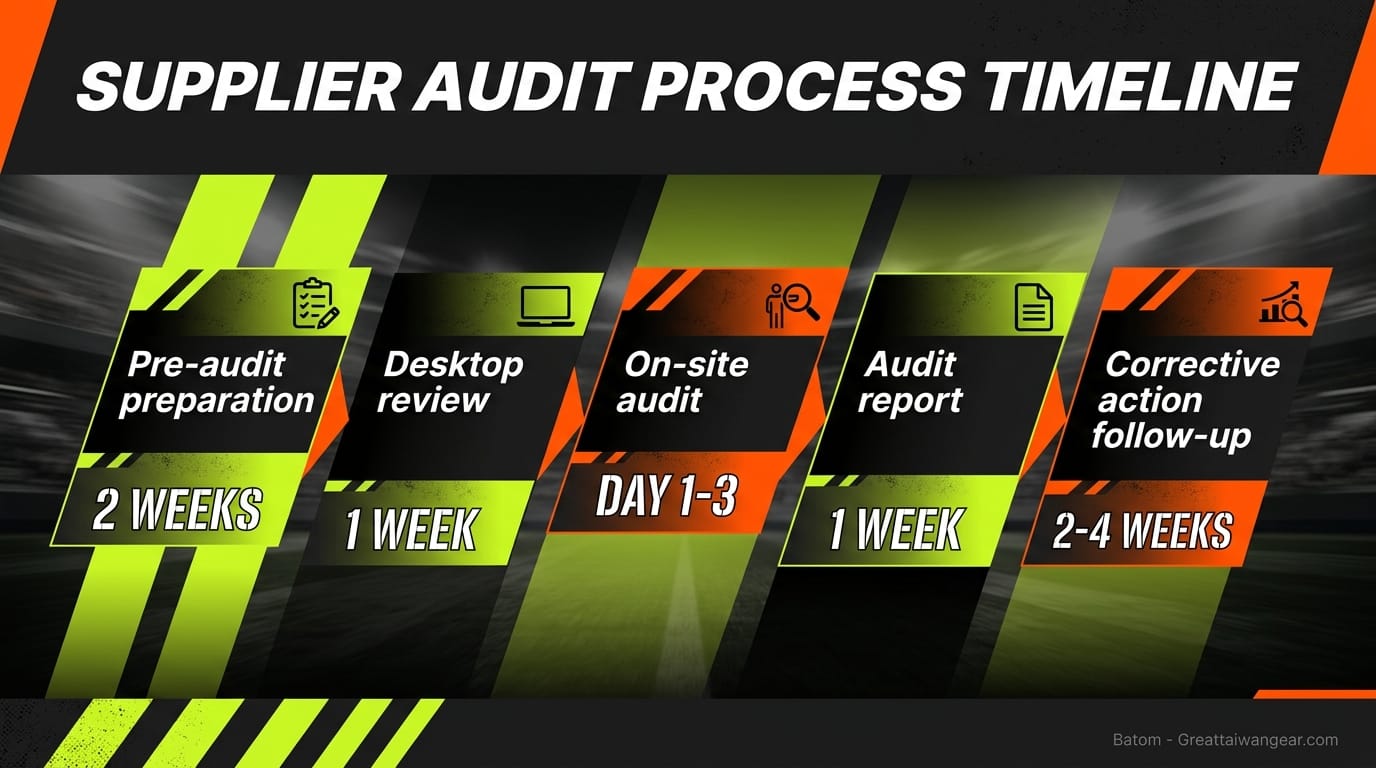
Schedule at least one on-site audit per finalist. The gap between submitted documents and actual shopfloor conditions is often the most revealing data point in the entire evaluation process.
Sources
- IATF Global Oversight — IATF 16949 Certification Rules — Current 6th Edition (2025)
- AIAG — Automotive Quality Core Tools & Standards
- AGMA — American Gear Manufacturers Association
- ISO — International Organization for Standardization
- MIT Sloan Management Review — Supply Chain Risk Management
About the Author
Batom Co., Ltd. Marketing Team Batom has manufactured precision gears since 1981 — over four decades of experience spanning automotive transmission gears, EV drivetrain systems, aerospace actuator gears, and industrial applications. Certified to IATF 16949 and multiple international standards, Batom offers end-to-end capability from gear design and analysis through production and quality verification.
Author's note: Across hundreds of supplier evaluations we've participated in — from both sides of the table — one pattern recurs. Buyers focus disproportionately on unit price while underweighting quality system maturity and technical service depth. In EV gear applications especially, a single NVH issue caused by improper flank modification can cost 5 to 10 times the original price difference to diagnose and resolve. This checklist is designed to shift the evaluation center of gravity from "who is cheapest" to "who is least likely to generate unexpected costs."
Ready to evaluate a precision gear supplier against these criteria? Schedule a consultation with Batom's engineering team to discuss your specific requirements — from gear design analysis to quality verification benchmarks.
Frequently Asked Questions
What certifications should a gear manufacturer hold for automotive supply? IATF 16949 is the mandatory baseline for any supplier entering the automotive supply chain. The standard builds on ISO 9001 and adds automotive-specific requirements for product safety, traceability, and supplier management. The IATF current 6th Edition (2025) emphasizes risk-based audit and supplier monitoring. Depending on the application, AS9100 (aerospace) may also apply. Batom holds ISO 9001 + IATF 16949 certification.
How do AGMA and DIN gear accuracy standards compare? The current AGMA standard is AGMA 2015-2-A06, which classifies gear accuracy from A2 (highest precision) to A11 (lowest). DIN 3962 uses a similar scale where lower numbers mean higher precision. In practice, AGMA A4 corresponds approximately to DIN 5, and AGMA A7 to DIN 8. The two systems measure similar parameters (pitch deviation, profile error, helix error) with slightly different methods, so exact equivalence depends on gear size and module. A qualified manufacturer should specify which standard they reference and provide measurement reports aligned to the buyer's preferred system.
What is a good Cpk threshold for automotive gear production approval? Most automotive OEMs require a minimum Cpk of 1.67 for initial production approval (PPAP). Some customers specify Cpk ≥ 2.0 for safety-critical components. The Cpk value measures how centered and consistent a manufacturing process is relative to its specification limits — a higher number means less variation and lower defect risk.
Why is NVH management particularly important for EV gear suppliers? Electric motors operate with far less background noise than internal combustion engines. Gear whine and transmission noise that would be masked in a conventional vehicle become clearly audible in an EV cabin. This makes flank microgeometry, surface finish quality, and gear mesh optimization critical for EV applications. Suppliers without specific NVH testing and optimization experience for electric drivetrains present a significant quality risk.
How long should a gear prototyping and PPAP process take? Typically 8–16 weeks total from engineering drawings to PPAP completion. Batom delivers in approximately 3 months for prototyping. A full PPAP submission — including dimensional reports, material certifications, process capability studies (Cpk ≥ 1.67 for production release), and control plans — is included in this timeline.